When I explain how to analyse a property deal in South Africa, I begin with a simple principle: a low asking price does not automatically make a property a good investment. A townhouse advertised for R900,000 in Centurion might look like a bargain, especially if the seller claims it could be worth substantially more after refurbishment. But the purchase price tells only part of the story.
Before considering an opportunity worth pursuing, I want to understand the demand for that property, its realistic market value and the full cost of buying, improving and holding it. Equally important is whether the potential rental income or resale proceeds justify the investment and its associated risks.
In this guide, I explain seven practical checks, using a hypothetical Centurion townhouse to demonstrate how structured, spreadsheet-based analysis can support better investment decisions.
Key Takeaways
- A low purchase price does not guarantee a good investment. Property demand, realistic market value and the property’s condition must support the investment case.
- Calculate the complete investment cost before estimating returns. Acquisition expenses, refurbishment, financing and ongoing costs can significantly affect profitability.
- Evaluate returns, risks and exit strategies together. Sound investment decisions require realistic projections, sensitivity analysis and a clear plan for recovering capital.
Table of Contents
1. Establish Whether There Is Genuine Property Demand
A property can be attractively priced and still be difficult to rent or sell. The first question is not whether it looks inexpensive, but whether enough potential buyers or tenants would find it desirable.
Look for Evidence of Local Demand
Start by examining recent comparable sales and rental activity in the immediate area. Speak to local property professionals about rental enquiries, typical vacancy periods and the types of properties attracting buyers or tenants.
Consider proximity to employment centres, transport routes, schools, shopping facilities and essential services.
A suburb’s overall popularity is useful context, but demand can vary significantly between neighbouring complexes and property types. An attractive location does not automatically guarantee strong demand for every property within it.
Match the Property to Its Target Market
A R900,000 townhouse in Centurion may appeal to a different market from an apartment in Midrand. Each should be assessed against comparable properties with similar features, security, condition and ownership arrangements.
For sectional-title properties, monthly levies, complex maintenance and management standards can also influence demand.
Before proceeding with detailed financial analysis, I would want reasonable evidence of achievable rental income, likely vacancy periods and resale prospects.
The first test is straightforward: does the property meet a genuine market need, or is its low price the main reason it appears attractive?
2. Determine the Property’s Realistic Market Value
Once there is evidence of demand, the next step is to establish what the property is actually worth. An asking price is not necessarily its market value, and claims that a property is available below market value should be supported by evidence.
Examine Comparable Property Sales
Identify recently sold properties in the same neighbourhood or residential complex. Compare their selling prices, floor areas, condition, security features and other characteristics that influence value.
Property portals provide useful information about current listings, but advertised prices do not establish what buyers are willing to pay. Recent registered sales, supported where necessary by a professional valuation, provide a stronger basis for assessment.
Verify the Claimed Investment Discount
Consider our hypothetical R900,000 Centurion townhouse.
Suppose the seller claims the property could sell for R1.1 million after refurbishment. The potential difference of R200,000 may sound attractive, but it is not an established discount or investment profit.
The R1.1 million figure must first be tested against comparable refurbished property sales. We must also account for the expenditure required to achieve that condition.
A property worth R1.1 million after improvements is not necessarily worth that amount in its present condition.
A credible investment case begins with a defensible valuation, not an optimistic claim about future selling prices.
3. Calculate the Complete Cost of Acquiring the Property
One of the most common mistakes in property investment is estimating returns using the purchase price alone. The full financial commitment can be considerably higher.

Include Transaction and Financing Costs
In South Africa, property purchases involve additional expenses, including conveyancing fees, Deeds Office registration fees and, where applicable, transfer duty.
Under the SARS transfer-duty schedule for 2026/27, the zero-duty band extends to R1,210,000. A qualifying R900,000 transaction would therefore attract no transfer duty, although other acquisition costs remain payable. Transactions subject to VAT require separate consideration.
Investors using mortgage finance must also account for bond registration costs, bank charges, the required deposit and ongoing financing expenses.
Property inspections, initial repairs and applicable municipal or levy adjustments may create further costs.
Establish the Total Investment Requirement
For our Centurion townhouse, I would use an investment analysis spreadsheet to record the purchase price and each additional expense.
The spreadsheet should distinguish between the total cost of the investment and the cash the investor must contribute, particularly when mortgage financing is involved.
Initial holding expenses and contingency allowances should also be included, while refurbishment costs should be recorded separately to avoid double-counting.
At Blue Phakwe Property, an initial assessment helps determine whether a property warrants further investigation. Property owners can submit a property for assessment for initial screening. Where an opportunity appears promising, more detailed financial modelling can establish its potential viability.
The important question is not simply whether the investor can afford the asking price, but whether the complete financial commitment is justified by the expected return.
4. Assess Property Condition and Refurbishment Costs
Properties requiring repairs can offer attractive investment opportunities, but unexpected refurbishment costs can quickly eliminate the potential profit.
I distinguish between cosmetic improvements, such as painting and replacing fittings, and more serious problems involving structural damage, roofing, plumbing or electrical installations.
Inspect Before You Estimate
A thorough inspection helps identify visible defects and potential problems requiring specialist assessment.
In transactions involving property practitioners, the Property Practitioners Act provides for a mandatory property condition disclosure. However, disclosure does not replace an independent property inspection.
Where significant defects are suspected, obtain professional assessments before committing to the purchase. Proposed improvements may also require municipal approvals or body corporate consent.
Build a Realistic Refurbishment Budget
Request itemised contractor quotations covering materials, labour and the expected completion period.
Include a contingency allowance and consider how delays could increase holding costs.
For our hypothetical townhouse, suppose the initial refurbishment budget is R80,000. If unexpected repairs increase that amount to R120,000, the additional R40,000 directly reduces projected profit, assuming other factors remain unchanged.
A spreadsheet makes it possible to test both scenarios before determining whether the purchase price remains attractive.
The potential value created by refurbishment must justify the cost, time and risks involved.
5. Calculate Cash Flow, Rental Yield and Return on Investment
A property may appear profitable based on rental income or expected resale value, but the numbers can change significantly once all expenses are considered.
I use spreadsheet-based financial analysis to evaluate potential investment performance rather than relying on headline rental yields or projected selling prices alone.

Understand Gross and Net Rental Yield
Gross rental yield measures annual rental income against the property’s purchase price or value, before expenses.
For our R900,000 townhouse, assume a monthly rental income of R7,500.
This produces annual rental income of R90,000 and a gross rental yield of 10%, calculated against the purchase price.
These figures are hypothetical and do not represent verified Centurion rental conditions.
Gross yield excludes important expenses such as municipal rates, sectional-title levies, insurance, maintenance, management fees and vacancies.
Net rental yield considers the impact of operating expenses. As explained in Property24’s guide to property investment metrics, investors should look beyond gross yield when evaluating financial sustainability.
Understand Cash Flow and ROI
Net operating income is rental income after operating expenses but before financing and income tax.
For financed properties, cash flow must also account for mortgage repayments. Cash-on-cash return compares annual cash flow after debt service with the investor’s actual cash contribution.
Return on investment (ROI) requires equally careful interpretation.
A refurbishment-and-resale project produces a return over the period of the transaction. A rental property generates recurring income over multiple years, potentially alongside capital appreciation.
These measures should not be compared without considering the investment period, capital requirements and risks.
Test the Financial Assumptions
I would not accept an attractive projected return without testing less favourable scenarios.
What happens if rental income is lower than expected, the property remains vacant for two months, interest rates increase or refurbishment costs exceed the original budget?
The spreadsheet should show how those changes affect cash flow, profitability and returns.
A reliable assessment is not about producing the highest possible ROI. It is about establishing whether the investment remains viable under realistic conditions.
6. Identify Legal, Financial and Transaction Risks
Even an attractive financial projection cannot compensate for unresolved legal or transaction risks.
Before committing to a purchase, establish whether restrictions, outstanding obligations or other conditions could affect ownership, costs or the intended investment strategy.
Verify Ownership and Property Obligations
Start by confirming the registered owner and examining the title deed for restrictions, servitudes or other relevant conditions.
The South African Government’s Deeds Registry service provides information about registered ownership and conditions affecting properties.
For sectional-title properties, request the body corporate’s financial statements, budgets, levy information and applicable management rules.
Pay particular attention to outstanding levies, reserve funds, planned maintenance and potential special levies.
Poorly managed sectional-title schemes can expose investors to unexpected expenses that are not apparent from the condition of the individual unit.
Investigate Transaction and Execution Risks
Establish whether the property has existing tenants or occupants, outstanding municipal obligations, unresolved disputes or compliance issues that could delay transfer.
These matters require investigation, including clarification of which obligations the seller or purchaser must settle under the transaction arrangements.
The sale agreement should also be reviewed by an appropriate conveyancing professional, particularly its conditions relating to financing, inspections, occupation and transfer.
An unexpected R30,000 special levy or a prolonged transfer delay could materially affect the investment case for our Centurion townhouse.
Some risks can be quantified and entered into the spreadsheet. Others require professional investigation or contractual protection.
A promising property should progress beyond initial screening only when material risks are understood and can be appropriately managed.
7. Test the Exit Strategy Before Making an Offer
Every investment assessment should address a fundamental question: how and when will the investor recover capital and generate a return?
A property that appears attractive as a refurbishment-and-resale opportunity may perform very differently as a long-term rental investment.
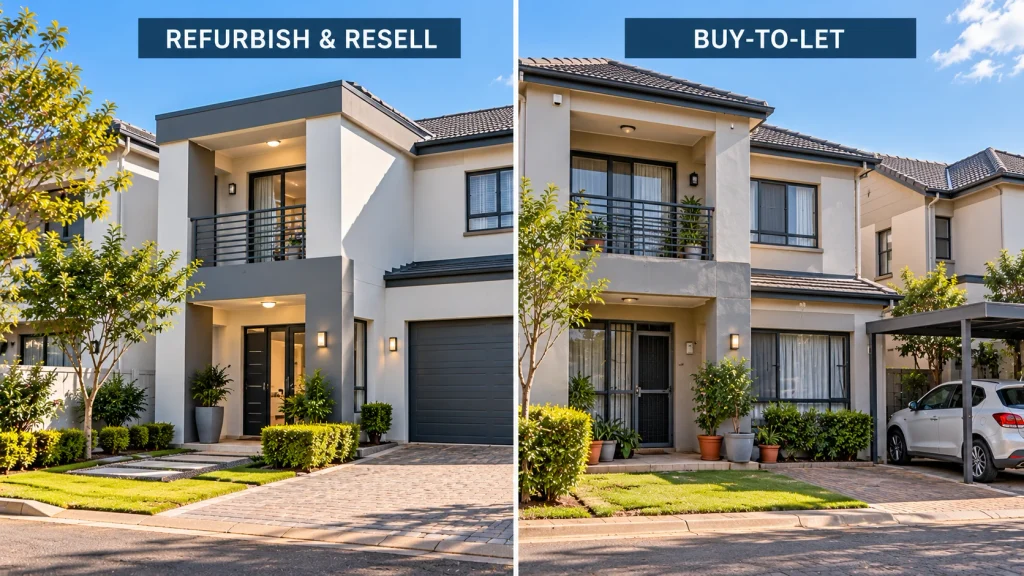
Compare Flipping with Buy-to-Let
For our townhouse, a refurbishment-and-resale strategy depends on achieving a realistic selling price after accounting for acquisition, renovation, holding and selling costs.
A buy-to-let strategy requires assessment of rental income, vacancies, operating expenses, financing commitments and longer-term resale prospects.
Each approach has different cash-flow requirements, investment periods and risks.
Consider Exit Timing and Tax
I would test what happens if the resale price falls, the property takes longer to sell or rental income does not meet expectations.
Tax treatment must also be considered. SARS explains that profits from property trading may be treated differently from capital gains arising from investment property disposals.
The appropriate tax treatment depends on the circumstances and should be confirmed with a qualified tax professional.
The preferred exit strategy should therefore reflect realistic assumptions, acceptable risks, available capital and the investor’s objectives—not simply the highest projected profit.
How to Analyse a Property Deal: A Worked Example
The seven checks become more useful when applied together.
Consider our hypothetical R900,000 Centurion townhouse. The seller believes it could sell for R1.1 million after refurbishment, but that estimate has not been independently verified.
I would begin with an initial assessment to establish whether the opportunity deserves more detailed investigation. The spreadsheet would then compare two potential investment strategies.
Scenario 1: Refurbish and Resell
| Investment component | Estimated amount |
|---|---|
| Purchase price | R900,000 |
| Acquisition and transaction costs | R35,000 |
| Refurbishment budget | R80,000 |
| Holding costs | R25,000 |
| Selling expenses | R45,000 |
| Total investment cost | R1,085,000 |
| Assumed resale price | R1,100,000 |
| Projected profit | R15,000 |
| Projected transaction ROI | 1.4% |
The figures assume an entirely cash-funded transaction. The projected profit is before income tax, and the 1.4% ROI relates to the whole transaction, not an annual return.
Despite the apparent R200,000 difference between purchase price and potential resale value, the estimated profit is only R15,000.
If refurbishment costs rise from R80,000 to R120,000, the investment produces a projected R25,000 loss.
This leaves very little margin for error.
Scenario 2: Buy and Rent Out
Suppose the same townhouse could generate R7,500 in monthly rent.
| Rental investment measure | Estimated amount |
|---|---|
| Annual potential rental income | R90,000 |
| Annual operating expenses and vacancy allowance | R42,000 |
| Annual net operating income | R48,000 |
| Initial investment, including refurbishment and pre-letting holding costs | R1,040,000 |
| Annual operating return on invested capital | 4.6% |
This assumes the same R25,000 pre-letting holding allowance used in the resale scenario, but excludes selling expenses because the property is retained.
The 4.6% return is before financing, income tax and future capital appreciation. It is an annual unlevered operating return on the stated capital invested, rather than a cash-on-cash return.
The assumed rental income, expenses and property value would require verification against local market evidence.
Property Investment Decision Scorecard
The spreadsheet provides financial outputs, but a decision also requires consideration of the broader investment case.
| Investment check | Assessment |
|---|---|
| Property demand | Local rental and resale evidence required |
| Market value | R1.1 million post-refurbishment estimate unverified |
| Acquisition costs | R35,000 estimated; quotations required |
| Refurbishment | R80,000 estimated; contractor inspection required |
| Investment returns | Resale margin weak; rental return requires further analysis |
| Legal and transaction risks | Title and sectional-title investigations outstanding |
| Exit strategy | Neither strategy sufficiently validated |
A practical assessment might produce one of four outcomes: Proceed to Further Due Diligence, Investigate Further, Renegotiate or Decline.
These are preliminary assessment outcomes, not instructions to purchase. The investor remains responsible for the final investment decision.
For this hypothetical property, my assessment would be Investigate Further, with a strong possibility of renegotiating the purchase price or declining the opportunity.
The example illustrates why structured deal analysis matters. A property that initially appears to offer substantial upside can become considerably less attractive once the complete investment costs and risks are considered.
Conclusion — Analyse the Deal Before Committing Your Money
A successful property investment begins with disciplined analysis, not simply finding a property at an attractive price.
As our Centurion townhouse example demonstrates, acquisition costs, refurbishment expenses, market conditions and financial risks can substantially change expected returns.
At Blue Phakwe Property, our focus is on sourcing residential property opportunities, assessing their investment potential and developing viable opportunities for further consideration. We are not a conventional property-listing service, and appropriate qualified professionals are involved where required.
Our assessments help clarify investment opportunities; they do not replace investors’ independent due diligence or final investment decisions.
Interested in Property Investment Opportunities?
Blue Phakwe Property is building a network of investors interested in carefully assessed residential property opportunities. Visit our Investor Network page to learn more about our approach and how to express your interest.
Joining the network is an expression of interest only and does not guarantee access to opportunities, deal flow or investment returns.
Frequently Asked Questions
Evaluate local demand, comparable sales, total acquisition costs, potential income, refurbishment requirements and investment risks. A promising opportunity should offer realistic returns supported by credible evidence and a viable exit strategy.
There is no universal benchmark. An acceptable return depends on financing, investment duration, market conditions and risk. Compare expected returns with alternative investments, considering both the capital required and the time over which returns are generated.
Add the purchase price, conveyancing and registration fees, applicable taxes, financing costs, refurbishment expenses and initial holding costs. Include appropriate contingencies and distinguish total investment costs from the cash required upfront.
No. A discounted property may require expensive repairs, have limited rental demand or carry legal and financial complications. The apparent discount must be verified against comparable sales and assessed alongside the complete investment cost.
The choice depends on achievable resale prices, rental demand, financing costs, investment objectives and risk tolerance. Compare the projected financial outcomes over appropriate investment periods and test the assumptions before making a decision.